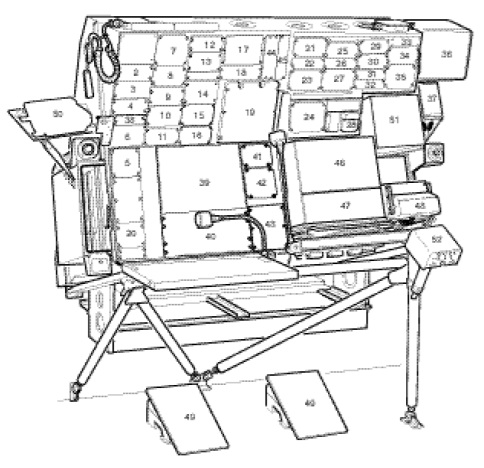
Some extra research on how we ended up with the ASN-501.
It’s clear that the 501 wasn’t a fall back from another plan, nor was it a result of Bonnie being taken out of service. It was “part of the plan” from the very start.
In the 127th Meeting of the Research Control Committee, 31 January 1963, item 127-3 “Navigation and Tactical Display System for ASW Helicopter” was presented.It specifically talked about having Sperry Gyroscope Company, who produced the ASN-501, investigate conversion of the ASN-30 (the USN nomenclature for the 501, first refered to as ASWTNS, Anti-subwarine Wareare Tactical Navigation System) for helicopter use. $80,000 was allocated for this work. There is a short briefing note attached to the minutes concerning this item.
Furthermore, the “Revised Staff Characteristics for an Escort Borne ASW Helicopter” dated 16 August, 1962, also includes a section labelled “Integrated Navigation and Tactical Display System. It is clear that it is written in such a way to indicate a system such as the ASN-501 (ASN-30). Notably, it also includes “it is desirable that an attack computer be provided to facilitate vectoring of surface or other air units to intercept the target.” This was never provided per se, but the combination of the 501 and dedicated TACCO provided the capability eventually, although the radar was required to fully realize it.
Of note, I also bought a copy of the USN NAVAIR 01-230HLH-1 NATOPS Flight Manual SH-3D/H Helicopters, Ch 1 1 December 1984, which still included a description of the ASA-13, the system the USN had available when the CHSS-2 was acquired. The ASA-13, apart from reliability issues, would not have met the required characteristics. Its primary limitation was the inability to assist robustly in creating a plot. The ASN-501’s red and green strobes are flexible enough to allow that and also other plotting functions, like the aforementioned attacks. However, to do so requires a heavier operator workload. The USN’s eventual solution was the ASN-123, a digital computer which could do all these functions and more with a much lower workload (although optimized as a pilot information computer, not a robust battle management system; ASP and MDMS are the latter).
So, it is clear that from at least 1962 the RCN was intending the CHSS-2 to be an independent platform (there are other supporting documents) and seeking to fit it as such. They also were aware of the requirements to do so. The paperwork trail is there for them to understand the workload of doing so in a challenging flight environment (low altitude, IFR, other traffic). My next step is to find the documentation, if it still exists, as to why the decision was taken to add a TACCO with a dedicated console housing the 501. My gut feel is there isn’t a single reason, but a convergence of events: need to have robust plotting capabilities, state of existing technology, availability of navs from the RCAF, impending disposal of Bonnie, and the RN model.
It is also not clear that when the RN model evolved into TANS (Tactical Air Navigation System), which was optimized for the use of a TACCO to do more robust battle management (primarily by integrating the radar with the plot), consideration was not given to acquiring it.
It does seem that the “accomplishment” of getting the “canadian” ASN-501 in the aircraft create a 25 year acceptance of that as “the best we could do.”