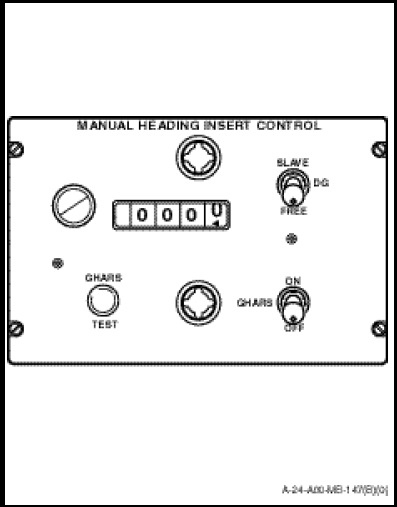
The MHIC panel (Figure 1-14-15) is located on the radio and navigation control panel and consists of the following controls:
a. A power ON/OFF lever lock switch is used to turn GHARS AC and DC power on or off. The switch requires a 3 to 5 pound pull to engage and disengage.
b. A GHARS TEST switch, when depressed, presents an indication of the verticality of the GHARS gyro reference unit, using the pilots VGI as an indicator when STBD is selected on the VERTICAL GYRO switch on the channel monitor control panel.
c. A knurled knob and counter, which is used to select and display true heading when it is desired to perform a manual alignment.
d. A two-position SLAVE/FREE lever lock switch permits the gyro reference unit to operate as a free directional gyro or slaved to the magnetic flux valve signal. With accurate initial alignment, operation in the FREE mode allows the variation to update automatically by permitting convergency correction signals to be applied to the DG so that it is accurately oriented to true north at latitudes between 70 degrees north and 70 degrees south. It provides the doppler, the AN/ASN-123C and the search radar with a highly accurate heading reference, and therefore is the most desirable mode for optimum navigation system performance. When the SLAVE/FREE switch is selected to SLAVE, the DG is slaved to the flux valve signal ± the variation inserted in the window of the gyro controller. Since the variation is locked in the controller when the
FREE/SLAVE switch is selected to SLAVE, navigation errors will occur as the aircraft flies to an area of differing variation. Because the DG follows the flux valve signal, and since the flux valve is subject to errors caused by aircraft manoeuvres, the DG will transmit these errors to the AN/ASN-123C, the doppler and the search radar. Manual updating of the variation readout may be performed in the slaved mode during flight by using the procedure described in HS (SMG) Manual, Section 3, Operations. The FREE/SLAVE switch requires 3 to 5 pounds pull to alternate selections.